


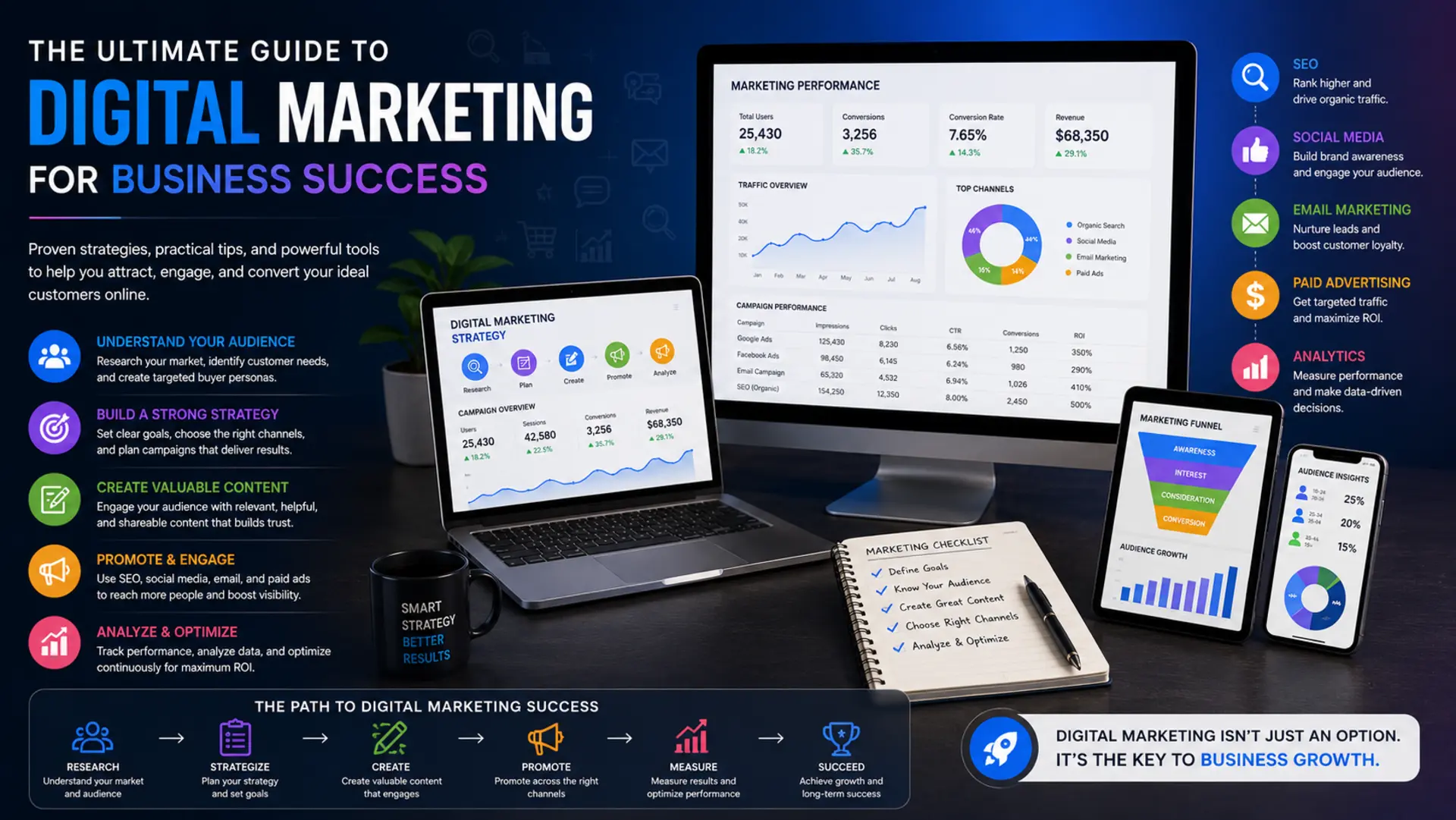
Digital Marketing has transformed the way businesses connect with customers, promote their products, and generate revenue. In today’s highly competitive online environment, digital marketing is no longer an option—it is a necessity for businesses that want to grow and remain relevant. Whether you run a startup, small business, eCommerce store, or large enterprise, digital marketing helps you reach your target audience, build brand awareness, and drive measurable results.
Unlike traditional marketing methods, digital marketing allows businesses to connect with potential customers through multiple online channels, including search engines, social media platforms, email campaigns, websites, and paid advertisements. By leveraging digital marketing strategies effectively, companies can increase website traffic, generate qualified leads, improve customer engagement, and boost sales.
In this comprehensive guide, we’ll explore everything you need to know about digital marketing, including its importance, key strategies, benefits, challenges, and future trends.
It refers to the use of digital channels and online technologies to promote products, services, and brands. It involves creating and distributing content, engaging with audiences, and driving customer actions through internet-based platforms.
It encompasses various channels, including:
The primary goal of digital marketing is to connect businesses with the right audience at the right time while delivering measurable results.
Modern consumers spend a significant portion of their time online. They research products, compare services, read reviews, and make purchasing decisions using digital platforms.
It helps businesses:
Without it, businesses risk losing visibility and falling behind competitors who actively engage online audiences.
Brand awareness is essential for attracting new customers and building trust.
It helps businesses increase visibility through:
The more frequently potential customers encounter your brand online, the more likely they are to remember and trust it.
One of the biggest advantages is its ability to attract highly targeted audiences.
Businesses can target users based on:
This precision allows companies to generate leads that are more likely to convert into paying customers.
Traditional marketing often makes it difficult to track performance.
It provides access to detailed analytics, including:
These insights help businesses optimize their marketing strategies and maximize return on investment (ROI).
Customers expect brands to communicate and interact with them online.
It creates opportunities for engagement through:
Strong engagement builds trust and strengthens customer relationships.
Search Engine Optimization (SEO) is one of the most powerful digital marketing strategies.
SEO helps websites rank higher in search engine results, making it easier for potential customers to find businesses online.
SEO includes:
Benefits of SEO include:
SEO remains a critical component of successful marketing campaigns.
Content marketing focuses on creating valuable content that attracts and engages audiences.
Popular content formats include:
High-quality content helps businesses:
Content marketing is often considered the foundation of modern marketing strategies.
Social media platforms provide businesses with opportunities to connect directly with customers.
Popular platforms include:
Social media marketing helps businesses:
Consistent social media engagement can significantly enhance brand visibility and loyalty.
Email marketing remains one of the most effective digital marketing channels.
Benefits include:
Successful email campaigns focus on delivering valuable content rather than simply promoting products.
Pay-Per-Click (PPC) advertising allows businesses to display ads on search engines and websites.
Popular PPC platforms include:
Benefits of PPC digital marketing include:
When managed effectively, PPC can produce excellent results.
Every successful campaign starts with clear objectives.
Common digital marketing goals include:
Goals should be specific, measurable, achievable, relevant, and time-bound (SMART).
Knowing your audience is essential for success.
Businesses should analyze:
Understanding customers helps create more effective marketing campaigns.
Content should solve problems, answer questions, and provide value.
Effective content is:
Valuable content builds trust and encourages customer loyalty.
Performance measurement is critical for optimization.
Important metrics include:
Regular analysis helps businesses improve campaign effectiveness over time.
A website serves as the foundation of digital marketing.
Without a professional website, businesses may struggle to convert visitors into customers.
Marketing and website development work together to:
A well-designed website maximizes the effectiveness of marketing campaigns.
Visual content plays a major role in digital marketing success.
Graphic design enhances marketing through:
Professional design improves engagement and strengthens brand recognition.
User experience directly impacts marketing performance.
Effective UI/UX design helps marketing campaigns by:
Even the best marketing campaigns can fail if users encounter poor experiences after arriving on a website.
Many businesses focus solely on paid advertising while neglecting organic search visibility.
SEO provides sustainable, long-term traffic growth and should be a core part of any digital marketing strategy.
Inconsistent posting and communication can reduce audience engagement.
Businesses should maintain a regular publishing schedule across all channels.
Mobile users account for a significant portion of online traffic.
It campaigns must be optimized for mobile devices to ensure positive user experiences.
Data-driven decisions lead to better results.
Businesses should regularly review analytics to identify strengths, weaknesses, and opportunities for improvement.
Artificial intelligence is transforming digital marketing through:
AI helps marketers improve efficiency and customer experiences.
Voice search is becoming increasingly popular through smart devices and virtual assistants.
Businesses must optimize content for conversational search queries.
Video content continues to dominate online engagement.
Popular formats include:
Video marketing will remain a major trend for years to come.
Consumers increasingly expect personalized experiences.
Future marketing strategies will focus on:
Personalization improves engagement and conversion rates.
The primary goal is to connect businesses with their target audience, generate leads, and drive sales through online channels.
Results vary depending on the strategy. PPC campaigns may generate immediate traffic, while SEO and content marketing often require several months to achieve significant results.
Yes. It provides cost-effective opportunities for businesses of all sizes to reach customers and compete effectively.
The most effective channel depends on business goals, industry, and audience. Most successful strategies combine multiple digital marketing channels.
Digital Marketing is one of the most powerful tools available for business growth in the modern era. By leveraging strategies such as SEO, content marketing, social media marketing, email campaigns, and paid advertising, businesses can attract new customers, strengthen relationships, and increase revenue.
As technology continues to evolve, digital marketing will become even more sophisticated and personalized. Businesses that embrace innovation, analyze data, and prioritize customer experiences will be best positioned for long-term success.
Whether you’re launching a new brand or scaling an established company, investing in digital marketing is essential for achieving sustainable growth and maintaining a competitive advantage in today’s digital marketplace.





Leave A Reply Now